



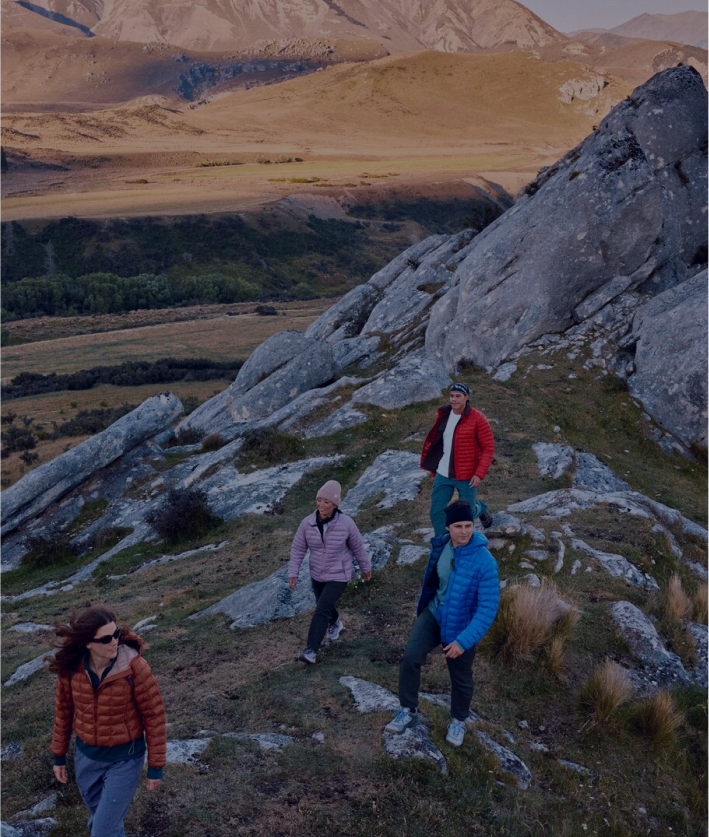
Meeting the Designers behind the XT Series.

Over two days at Castle Hill, deep in the Southern Alps, we put XT Series through its paces and went behind the design with the people who built it. April Burrows (Head of Design), Chad Leeder (Head of Materials) and Daan Dijkstra (Senior Product Manager) sat down with media and outdoor specialists to talk through the process.
Kathmandu ambassador Gemma McCaw hosted one of the designer sessions. Gemma has been part of the XT Series journey from early development through to real use on the trail.
"I liken the XT Series range to a good friend," she said. "It always has your back. It keeps you warm. It quietly gives you the confidence to say yes to adventure."
Here's some of what came up.
The name has history
XT Series isn't new. Kathmandu ran a range under that name years ago, alpine-focused, heavy, built for a different job entirely.
"It was quite traditional in many ways. Quite heavy, quite burly," Daan said.
That range quietened down over a decade ago. The new XT Series keeps the name and the technicality; it's just pointed at a different kind of hiking now, long-distance, multi-day, comfort-first, not alpine ascents.
"There's never a wrong time to make cool gear," Daan said. "We're in it because we love the gear."
Who the XT Series is designed for
Anyone trying to go further without the gear working against them.
"What looks fast for one person is different to someone else. We all have different speeds, we all have different bodies," April said. "XT Series allows you to make the most of your ability, go a little bit further, for you."
"The industry is getting progressively lighter, but it often comes at a huge sacrifice," April said. "Sometimes durability, or longevity, is seriously sacrificed at the altar of getting the lightest gear possible. For us, it was always a tandem approach."
Down to the fibre
Chad's team didn't buy fabric off the shelf. They went back to the fibre and rebuilt from there.
CORDURA® comes in a lot of forms. Most people know it from heavy 400-denier pack fabric. "We're like, alright, we've got this great fibre that has a good element of durability. What can we do with it?" Chad said. Working mostly with mills in Japan, the team pushed for a version that kept real durability instead of the lighter, weaker version the market usually settles for.
Octa® works the same way. "Octa® is a fibre-level technology. It's not a fabric, it's the name of the fibre itself, which has eight sides around it, like a star shape," Chad said. That's what gives it the quick-dry, warmth-without-weight the range leans on. They even varied the fibre thickness inside a single garment: finer against the skin, coarser on the outside for abrasion resistance.
Chad's trip to the mills in Japan stuck with him for another reason. The mills run on renewable power, some of it drawn from the compost and offcuts of neighbouring lumber and textile operations. "From top to bottom, the sustainability metrics and the technicity metrics are met,” Chad added.
Building it as a system
The harder job wasn't any single piece. It was making sure nothing about wearing them together caused friction.
"The tiniest of detail can start disrupting you, a seam placement, a pain point, physically, emotionally, mentally," April said. That included how loud the fabric is when it rubs together on the move. "We tried our best to keep these quiet, so you can stay focused and take in the surroundings."
It wasn't a straight line. Several prototypes never made it past internal testing. A few alternatives to Octa® were seriously considered and dropped. Staff tested early versions first. Then a wider group of external testers, Gemma among them, put real miles on it before anything was locked in.
The design behind the 40L XT Series Pack
The foamless, ribbed back panel resists moisture and dries fast rather than being cut to save grams. It's built from Aluula, a sailcloth-derived polyethylene the team considers the strongest fabric they've used, in two weights: a lighter 125gsm through the body, a heavier 155gsm reinforcing the base.
Every element is a decision.
Sustainability at the fibre level
Recycled CORDURA® wasn't an upgrade option, it was the baseline. The team also pushed for mono-material construction where they could, building garments from a single fibre type instead of a blend, since blends are much harder to recycle.
Small details, real reasons
There's no woven fabric across the back of the Octa Fleece Hybrid Midlayer. Not a weight-saving shortcut, deliberate ventilation, positioned exactly where a hiker sweats most under a loaded pack.
The rain jacket has no hand pockets, one larger chest pocket instead, which the team decided served hikers better on balance.
One detail kept coming up: how quiet the gear is. Most technical fabric makes that shh-shh-shh sound when it rubs against itself on the move. The design team spent a long time engineering that out, not for the fabric's sake, so people can actually hear the trail around them, not just their own jacket.
Nothing on XT Series is there by accident. The design team have worked on every detail to make the experience for users seamless.

Related Articles

UPF Clothing vs Sunscreen: Do You Need Both?
4 minute read

Camping with kids: The ultimate guide to fun, safe family adventures in NZ
5 minute read

What to Pack for a Day Hike: The Complete Checklist
There's a certain feeling that comes with a hike day. The gear laid out the night before. Boots by the door. That thrill of knowing you're about to spend a whole day outside. Getting your pack right is part of that.
4 minute read

On the Kauaeranga Kauri Trail with Ladies Who Venture
4 minute read
UPF Clothing vs Sunscreen: Do You Need Both?
4 minute read
Camping with kids: The ultimate guide to fun, safe family adventures in NZ
5 minute read
What to Pack for a Day Hike: The Complete Checklist
There's a certain feeling that comes with a hike day. The gear laid out the night before. Boots by the door. That thrill of knowing you're about to spend a whole day outside. Getting your pack right is part of that.
4 minute read
On the Kauaeranga Kauri Trail with Ladies Who Venture
4 minute read